Determining Channel Capacity and diagonalizing matrix D
Determining Channel Capacity
For a particular Trellis diagram we define a connection matrix D. Hence for k states the size of the matrix is k × k. D is called the connection matrix because its entries dij = number of Trellis paths from Si to Sj. For example
Notice that elements in a particular
ith row represent the number of paths from
Si.
The connection matrix
D is therefore a transition matrix from the present state to next state. Therefore after a certain time
t and hence
t steps, for a particular state
Si can we compute the possible number of paths (and hence possible number of sequences) that can reach the same
Si state? The possible number of sequences at
t steps can be computed by applying
D. This is illustrated below.
❶
If
then
If
t = 0 ⇒ no steps are taken and hence
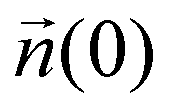
where
then, at
t > 0
For example, if
which is graphically
Then, at
t = 1
Hence the Trellis diagram is
❷
Similarly at t = 2
whose diagram is
❸
Therefore if
then
Hence at
t = 3
Since by definition
and
k = 2 for the two states
S0 and
S1 at
t = 3
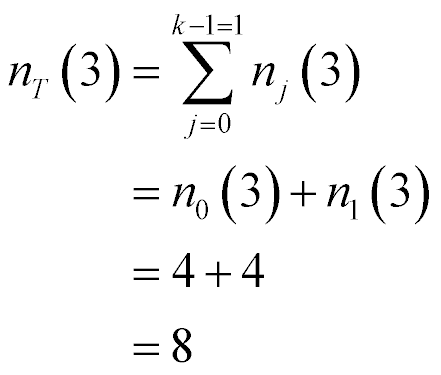
Hence the possible number of Trellis paths (reaching

and

) at
t = 3 is
❹
We know that ![vector n(3) = [4, 4]](math/Nat3equalsvector4and4.gif) and hence
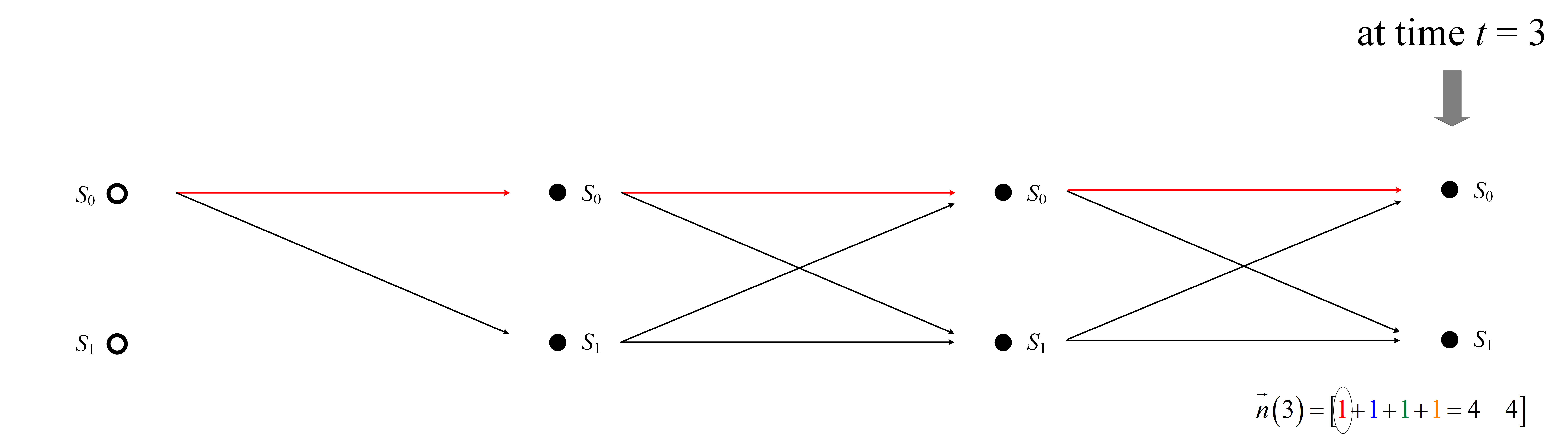
and hence  which implies there are four possible ways (same as four possible Trellis paths) from state S0 at t = 0 to S0 at t = 3. Graphically,
And hence similarly for

or four possible ways (same as four possible Trellis paths) from state
S0 at
t = 0 to
S1 at
t = 3. Therefore the possible number of Trellis paths from
S0 at
t = 0 to
S0 and
S1 at
t = 3 is eight,

.
Hence
 gives the possible number of distinct messages (sequences) that can be sent by the channel in exactly t steps.
Since the number of bits required to represent symbols in
sequences (in
t steps) is
the possible number of distinct messages
corresponds to
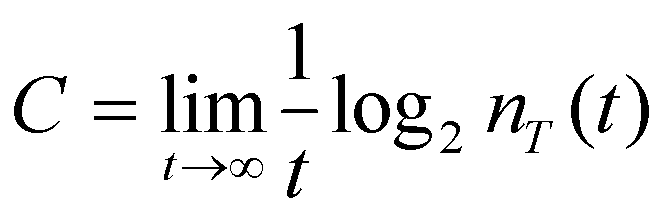
The channel capacity or maximum information rate or maximum mutual information between
X and
Y for such class of channels with memory is
❺
Alternative to determining for computing channel capacity
In practice it is hard to compute  and , in
  . Therefore it is hard to compute the channel capacity by the approach of determining . An easier approach is to diagonalize D.
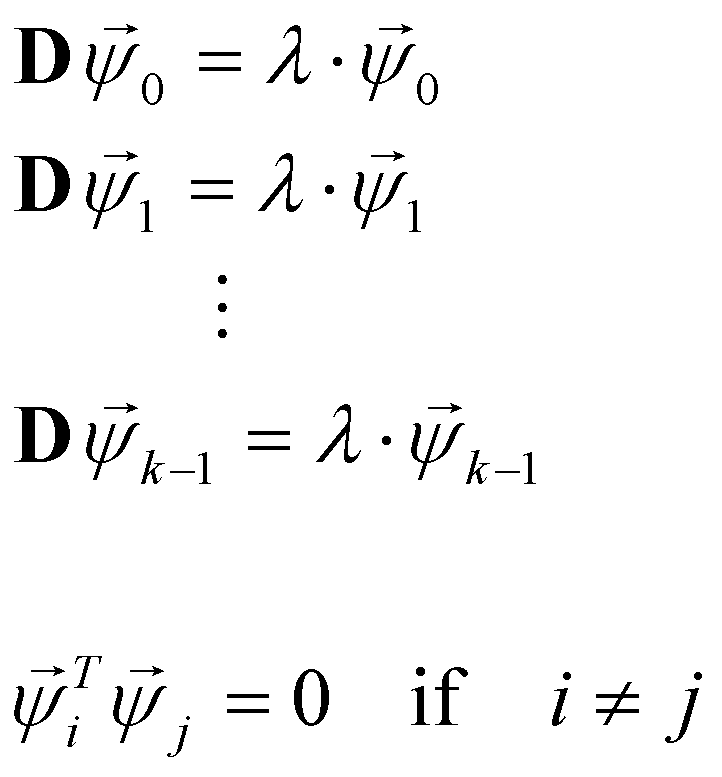
Let
Note that
where
k is the number of states. Also let the orthonormal

eigenvectors of
D form the columns of the modal matrix
Then
Thus
❻
In general
where
Therefore
where
Cj are constants because they are derived from
U−1,
U and their constants.
If λm is the largest positive eigenvalue of D, then for very large t
Thus
Plugging this into the channel capacity
the maximum channel capacity is
But as
t → 0,

thus the maximum channel capacity is
❼
Example
From det(
D −
λI) we get
Hence for maximum channel capacity
Note that
Cm =
H(
X) implies lossless channel.
❽


![vector n(t) = [n sub 0 at t, n sub 1 at t, ellipsis, n sub k-1 at t]](math/defineNatt.gif)

![vector n(0) = [1, 0] and D = [1, 1; 1, 1]](math/Nat0andDEgValues.gif)

![vector n(1) = vector n(0) times D sup 1 = [1, 0] times [1, 1; 1, 1] = [1, 1]](math/Nat1equalsNat0timesDsup1ComputeEg.gif)

![vector n(2) = vector n(0) times D sup 2 = [1, 0] times [2, 2; 2, 2] = [2, 2]](math/Nat2equalsNat0timesDsup2ComputeEg.gif)


![vector n(3) = vector n(0) times D sup 3 = [2, 2] times [1, 1; 1, 1] = [4, 4]](math/Nat3equalsNat0timesDsup3ComputeEg.gif)
![vector n(3) = [n sub 0 at 3, n sub k-1 at 3]](math/Nat3equalsnsub0nsubkminus1at3Eg.gif)





![U = [Psi sub 0, Psi sub 1, ellipsis, Psi sub k-1]](math/modalMatrixU.gif)


![Lambda sup t = [lambda sub 0 sup t, 0 , ..., 0; 0, lambda sub 1 sup t, ..., 0; ellipsis; 0, 0, ..., lambda sub k-1 sup t]](math/Lambasupt.gif)


![D = [1, 1; 1, 1] and det(D - lambda times I) = lambda squared - 2 times lambda](math/detDminuslambdaIComputeEg.gif)


